How to Grow Your Trades Business Across Multiple Locations Without Losing the Quality That Built It
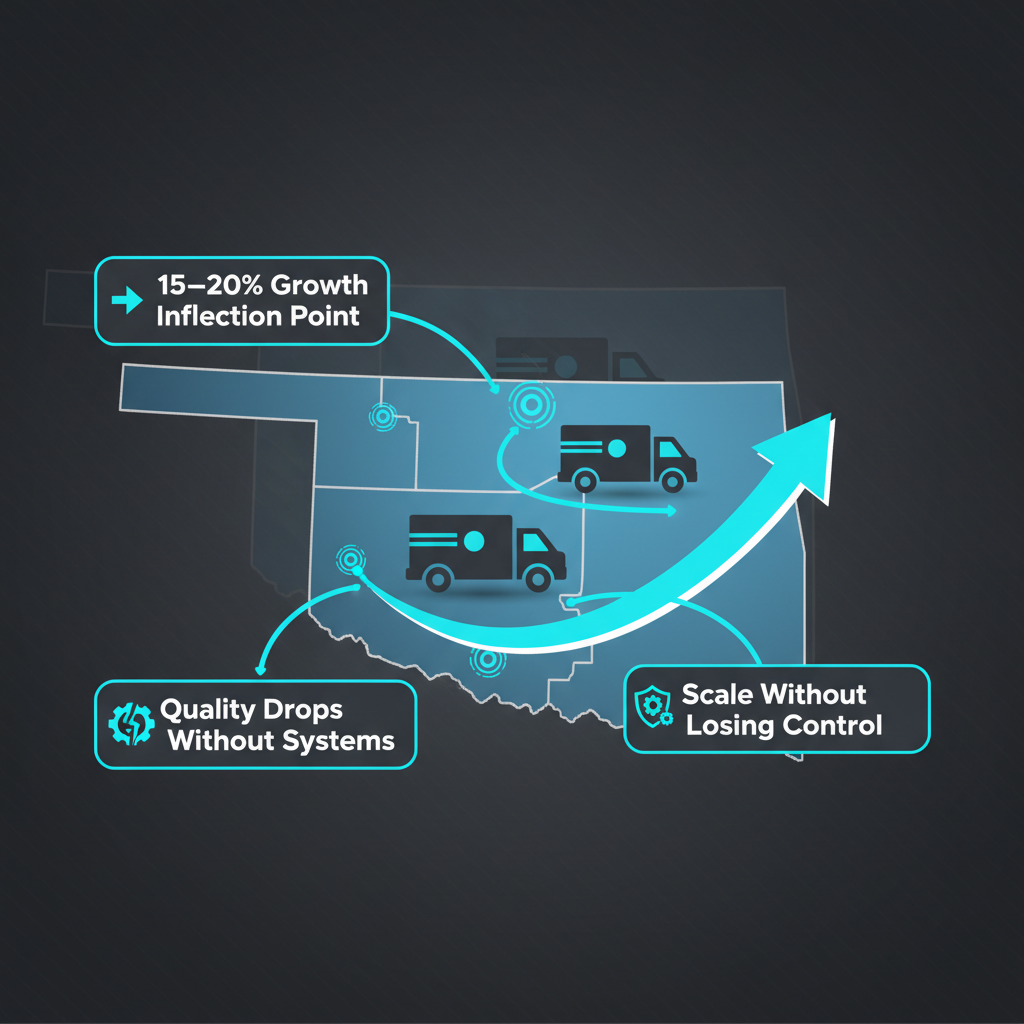
[Direct Answer] Most contractors experience a critical inflection point around 15-20% growth where their organization can no longer support its own success without structural change. When scaling across multiple locations, the risk is compounded: rapid hiring, delegation failure, and cultural erosion typically occur simultaneously. Steel Blueprint helps multi-location trades businesses implement the operational and dispatch infrastructure that prevents quality degradation during expansion — keeping the owner in control while the business grows.
Introduction
You built your first location on reputation. On your name. On being personally available when something went wrong.
The second location is different. You can't be in two trucks at once. You can't personally answer every call. And the moment you step back from daily operations, quality becomes invisible — until a customer calls with a problem you didn't know existed.
That's when most trades businesses hit the wall.
Expansion isn't about adding another location. It's about building systems that scale your standards, your culture, and your accountability across multiple crews working in multiple areas — without losing the owner's direct control or the quality that got you here.
Here's what the data says about why contractors fail at this — and what the ones who succeed do differently.
Why Most Trades Businesses Fail at Multi-Location Growth
The numbers are sobering. A critical inflection point typically occurs around 15-20% growth, where the organization can no longer function with the flat structure that worked for a single location. At that growth rate, owners working 14-hour days overseeing every decision become operational bottlenecks — and burnout follows.
The problems compound predictably:
Labor and Training Collapse Rapid expansion without a realistic assessment of labor availability typically leads to rushed hiring decisions. Contractors bring on field, office, or management staff with limited experience simply to keep up with demand. The result: costly rework, safety risks, project delays, and — most critically — customers noticing quality degradation.
Core Competency Drift In pursuit of growth, leaders often take on work outside their historically proven strengths — new materials, new installation methods, unfamiliar customer expectations. This lack of familiarity creates a steep learning curve. Mistakes increase, margins shrink, and profitability suffers.
Cultural Erosion Early warning signs of cultural decline during growth appear in subtle but telling ways: customers start noticing quality issues at facilities, employees resign without notice, energy and engagement fade. Training, safety, recognition, and career development — once hallmarks of the company — receive less attention as leadership focuses on keeping up. When employees are less experienced, culture erodes quickly, and with it their desire to stay.
The Leadership Vacuum Successful single-location contractors typically grew up with flat organizations, where the founder was involved in nearly every decision. That structure works until it doesn't. At the 15-20% growth threshold, the organization is no longer structured to support its own success. Delegation and middle management become non-negotiable — not just adding a project manager, but rethinking how the entire company functions.
The HVAC and plumbing industries are particularly vulnerable. The U.S. HVAC market is worth $156.2 billion and growing at 7.5% annually, but qualified labor remains scarce — there are 110,000 open technician positions unfilled. That scarcity makes rushed hiring decisions tempting, and the consequences are immediate: on a second location, the owner loses the direct oversight that protected quality on the first.
The Cost of Allowing Quality to Degrade During Growth
It's not abstract. Every quality drop at a second location has a direct consequence.
Customers notice. A poorly installed system, an incomplete service call, a crew that doesn't show up on time — these are the moments that destroy the reputation built over years. And the damage spreads: in local markets, one unhappy customer becomes a hole in your review profile that affects not just that location, but both locations.
Financially, the math is brutal: - Rework costs — fixing mistakes made by undertrained crews - Callback rates — untrained staff generate higher callback percentages - Margin erosion — lower productivity per technician and inefficient scheduling at location 2 - Customer lifetime value collapse — lost repeat business when quality expectations aren't met - Employee turnover costs — experienced staff leave when standards slip, forcing more rushed hiring
In the HVAC industry, customer lifetime value averages $15,340 per customer, but acquisition cost runs $296-350. A single lost customer due to quality issues at your second location costs you far more than you paid to acquire them.
Add in the compounding problem: as quality degrades, the owner's attention fractures further, spending more time on damage control than strategic growth. The business becomes harder to run, not easier.
How Scaling HVAC, Plumbing, and Electrical Contractors Keep Quality Intact
The contractors who successfully scale to multiple locations do four things differently:
1. Build Systems Before You Build Locations
Operational standardization is not optional. Before adding location 2, document everything: service procedures, quality checklists, response protocols, scheduling logic, customer communication templates, technician training pathways.
These systems become your invisible quality control. They're what allow a manager at location 2 to make the same decisions you would make — without you being there.
For a plumbing or HVAC contractor, this includes: - Dispatch logic — how jobs are assigned to technicians based on skill and location - Quality verification — how you confirm work standards at a location you don't directly manage - Pricing and proposal consistency — so both locations quote the same value for the same work - Service standards — response times, callback protocols, customer communication
2. Automate Front-End Dispatch and Lead Qualification
This is where multi-location contractors often stumble. When you had one location, you handled intake personally. You knew which jobs fit your crew's strengths. You could decide in real-time what got booked and what didn't.
At location 2, you can't be on every call.
An owner-controlled Virtual Front Desk system handles this layer — responding to every lead instantly, qualifying against your criteria, and routing jobs to the location with capacity and fit. The system uses rules you define: service area coverage, crew specialties, pricing thresholds, availability windows.
The result: every lead is processed the same way at both locations. No jobs slip through because dispatch was distracted. No untrained staff are making judgment calls on job acceptance.
For multi-location contractors specifically, this means: - Geographic routing — jobs automatically route to the nearest location with available crews - Skill-based assignment — a plumbing emergency goes to the crew trained on emergency repair, not the crew trained on new install - Load balancing — work distributes across locations based on real-time capacity, not guesswork
3. Protect and Systematize Technician Development
This is the cultural lever. Experienced technicians are your quality insurance. But when a new location launches, there's pressure to pull your best people to the new site, leaving location 1 understaffed and reliant on new hires.
That's backwards. Instead: - Assign a proven tech to lead location 2 — someone who knows your standards and can train others - Create a formal training pathway — new hires at location 2 shadow proven techs before flying solo - Invest in certification and skill development — technicians who see advancement opportunities stay longer - Measure and communicate quality metrics — let crews see how they compare, and celebrate when standards are maintained
The contractors who scale successfully protect their existing team, not stretch them to the breaking point. The upfront investment in training is far cheaper than the cost of losing experienced staff or fixing rework.
4. Create a Unified Command Structure Without Adding Overhead
This is the organizational design challenge. As you scale, you need: - Clear delegation — a location manager at site 2 who has authority to make decisions without calling you for approval on every job - Transparent communication — frontline technicians at both locations understand company values, customer standards, and growth direction - KPI alignment — both locations track the same metrics: quality, customer satisfaction, margin, response time - Aligned accountability — the location manager at site 2 is evaluated on the same standards as you evaluated yourself at location 1
This doesn't require a massive overhead hire. It requires clarity. A manager at location 2 needs to understand not just what to do, but why you made those choices at location 1 — so they can make the same judgment calls.
The Local Advantage Section: How Fortune 50 Systems Thinking Applies to Multi-Location Trades Businesses
The founder of Steel Blueprint built AI systems for a $34 billion global portfolio at a Fortune 50 company. That background taught him something critical: scaling is not about working harder. It's about designing systems that make good decisions automatic.
At a Fortune 50 company, you don't scale by hiring more people who think like the founder. You scale by building infrastructure so the founder's judgment becomes embedded in the system.
The same principle applies to scaling a plumbing or HVAC business from one location to two, three, or five.
A second location doesn't fail because the owner isn't smart enough. It fails because the operational layer — intake, dispatch, qualification, delegation, quality verification — was never systematized. The owner's judgment stayed in their head instead of becoming the business.
Steel Blueprint was built by someone who spent time on Oklahoma job sites. The founder isn't a tech executive who learned about trades from a blog. He has laid sod, built barns, and felt the pressure of a service truck idling in a heatwave. He sits on the board of the Hoof and Hero Sanctuary, is active in the Yukon Chamber of Commerce, and is invested in this community in ways that matter.
That's why the Virtual Front Desk is built the way it is. It's not designed by a SaaS company trying to force trades into a generic workflow. It's designed by someone who has stood where a multi-location contractor stands — managing multiple crews, balancing quality with growth, and trying to keep the business from fracturing as it scales.
The system is owner-controlled. Not a subscription dashboard that becomes invisible. Not a call center that handles intake but doesn't understand your standards. Operational infrastructure that you define and you control.
What the Data Shows About Multi-Location Growth
The HVAC and plumbing industries are in a period of sustained growth. The U.S. HVAC industry is valued at $156.2 billion in 2025, growing at 7.5% annually. Equipment sales alone ($31.7 billion) are matched by service revenue ($28.2 billion) — meaning the business is equally about relationships and ongoing work as it is about equipment.
That creates the opportunity for multi-location growth. Homeowners have 10-15 year old systems facing repair-or-replace decisions. The work is there.
But the critical constraint is labor. There are 110,000 unfilled technician positions in the U.S. HVAC industry alone. Adding a second location doesn't solve the labor shortage — it compounds it. Your best people are being pulled in two directions, and new hires are trained faster than they should be.
The contractors who win at multi-location growth don't solve the labor shortage. They solve the operational shortage. They systematize decision-making so that each location functions with consistent quality and efficiency even when staffed by newer technicians.
And they do it before they hit the growth wall. The 15-20% growth inflection point is a warning signal, not a finish line. By that point, the problems are already embedded. The time to build systems is before you add location 2, not after it's failing.
How to Execute Multi-Location Growth Without Losing Control
The roadmap is straightforward:
Phase 1: Document and Test (Before Location 2 Opens) - Write down how you handle dispatch, intake, customer communication, technician assignment, quality verification - Test these systems at location 1 — you're going to live by these rules at location 2, so make sure they work - Build or integrate the tools that automate this — dispatch software, intake management, job routing
Phase 2: Hire and Train Location 2 Leadership - Assign a proven technician or manager to lead location 2 — someone who knows your standards - Make it clear that their job is to replicate your standards, not innovate around them - Create a detailed training plan for the first 90 days
Phase 3: Implement Owner-Controlled Dispatch Infrastructure - Set up a Virtual Front Desk that handles intake for both locations - Configure it with your rules: service area, pricing, job acceptance criteria, technician assignment logic - Test with real calls before location 2 launches
Phase 4: Launch with Structure, Not Hope - Both locations operate by the same playbook on day 1 - The owner still has visibility and control, but through systems, not through being in two trucks at once - Measure quality, response time, and margin at both locations — make the metrics visible
Phase 5: Measure, Adjust, Repeat - Track whether quality, customer satisfaction, and margin are consistent across locations - When they're not, the issue is usually the system, not the people - The owner's job is to refine the system, not micromanage the crew
The Local Advantage: Why a Neighbor Beats a National Platform
When you're scaling a trades business, you need someone who understands what you're building. Not a generic SaaS platform that works for call centers in Des Moines. Not a national franchise system that forces you into a template.
You need someone who has lived in Oklahoma, worked in the trades, and built Fortune 50 infrastructure systems. Someone accountable to this community — literally invested in its success because they live here.
That's the difference between partnering with Steel Blueprint and partnering with a national platform. Steel Blueprint was built by the Founder for Oklahoma trades businesses. If something breaks, you call someone who understands your market, your crew dynamics, and your growth stage. Not a help desk in another state.
Five founding partner slots are open in Oklahoma right now. When they close, the territory locks.
→ Claim Your Partner Slot → See How the Virtual Front Desk Works → See What Your Multi-Location Growth Could Look Like
Frequently Asked Questions
Q: At what point should I open a second location? A: When your first location is consistently generating 20+ booked jobs per week and you have a manager ready to lead location 2 — someone who knows your standards and can replicate them. Don't scale because you have extra cash. Scale because you have the operational systems and the people to make it work.
Q: How do I keep quality consistent across locations? A: Through systems and measurement. Document your standards at location 1, implement them before location 2 opens, and measure quality metrics weekly at both locations. The moment quality drops, the issue is usually a system breakdown, not individual technician incompetence. Fix the system.
Q: What should I look for in a location 2 manager? A: Someone who has worked in your location 1 environment, knows your standards intimately, and has proven they can make good decisions within your framework. They don't need to be an entrepreneur — they need to be someone who respects your vision and can execute it. Ideally, it's your best technician promoted, not someone hired from outside.
Q: How many technicians do I need at location 2? A: Start with one seasoned tech from location 1 (the manager) and 2-3 trained/newer techs. You can grow from there. The bottleneck is never the number of people — it's the quality of training and the clarity of systems. One well-trained tech with clear standards beats three undertrained technicians flying solo.
Q: Will a Virtual Front Desk help with multi-location dispatch? A: Yes. It's actually more valuable at location 2 than location 1 because the owner can't be hands-on in dispatch decisions. The Virtual Front Desk handles intake for both locations, qualifies leads the same way, and routes jobs to the location with capacity and fit. It gives you visibility and control without you being in two trucks at once.
Q: What if location 2 fails? A: Close it before it destroys location 1. If you've built proper systems and a quality manager, location 2 won't fail for operational reasons — it will fail for market reasons (wrong service area, insufficient demand) or people reasons (wrong manager). Those failures are recoverable. What's not recoverable is letting a failing location 2 pull down location 1's quality, margin, and culture.
Conclusion
Growth is seductive. A second location feels like progress, like proof that you've built something bigger than yourself.
But the moment you stop being personally involved in every dispatch decision, every technician hire, every customer interaction, the business changes fundamentally. The owner-centered model doesn't scale. Something has to replace the owner's direct oversight.
For contractors who scale successfully, that something is operational infrastructure. Systems that make good decisions automatic. Dispatch logic that routes jobs the way the owner would. Training pathways that produce technicians who meet the owner's standards. Quality metrics that tell you when something's wrong before customers notice.
The contractors who fail at multi-location growth didn't fail because they lacked ambition or market opportunity. They failed because they tried to scale without changing the operational layer. The owner became a bottleneck, quality degraded, culture eroded, and what should have been a growth opportunity became a distraction.
You don't scale by working harder. You scale by building systems that work when you're not there.
→ Start Your Multi-Location Growth Plan
Sources
- ACHR News — How to Keep Growth From Breaking the Business
- Leads4Build — 2025 HVAC Industry Statistics
- PHCC — Key Trends for P-H-C Contractors in 2025
- ServiceTitan — HVAC Supply Chain Issues and Mitigation Strategies
- FieldProxy — 15 HVAC Business Statistics
- Marhy — Optimizing Multi-Location HVAC Crew Management
- SmartAC — The HVAC Business Model That's Dying
- Steel Blueprint — The Blueprint